The Carnotaurus Courtship Dance: What's Real, What's Guesswork
PALEODEX · 19 July 2026 · 6 min read
A male Carnotaurus clears a forest arena, bellows, and launches into an elaborate courtship display: bowing, waving its tail, rearing up, twirling tiny arms to flash blue skin underneath. The female watches, unimpressed, and walks away. It's one of the most talked-about scenes in Prehistoric Planet. Here's exactly how much of it is fossil, how much is a real scientific argument, and how much is educated guesswork in very convincing CGI.
Mythbusting a CGI dinosaur scene sounds like it should end in a flat "fake." It doesn't. The honest answer sits in three tiers: real fossil fact, genuinely contested science, and explicit speculation. All three are worth walking through separately, because the show blends them seamlessly.
Tier 1: what's real
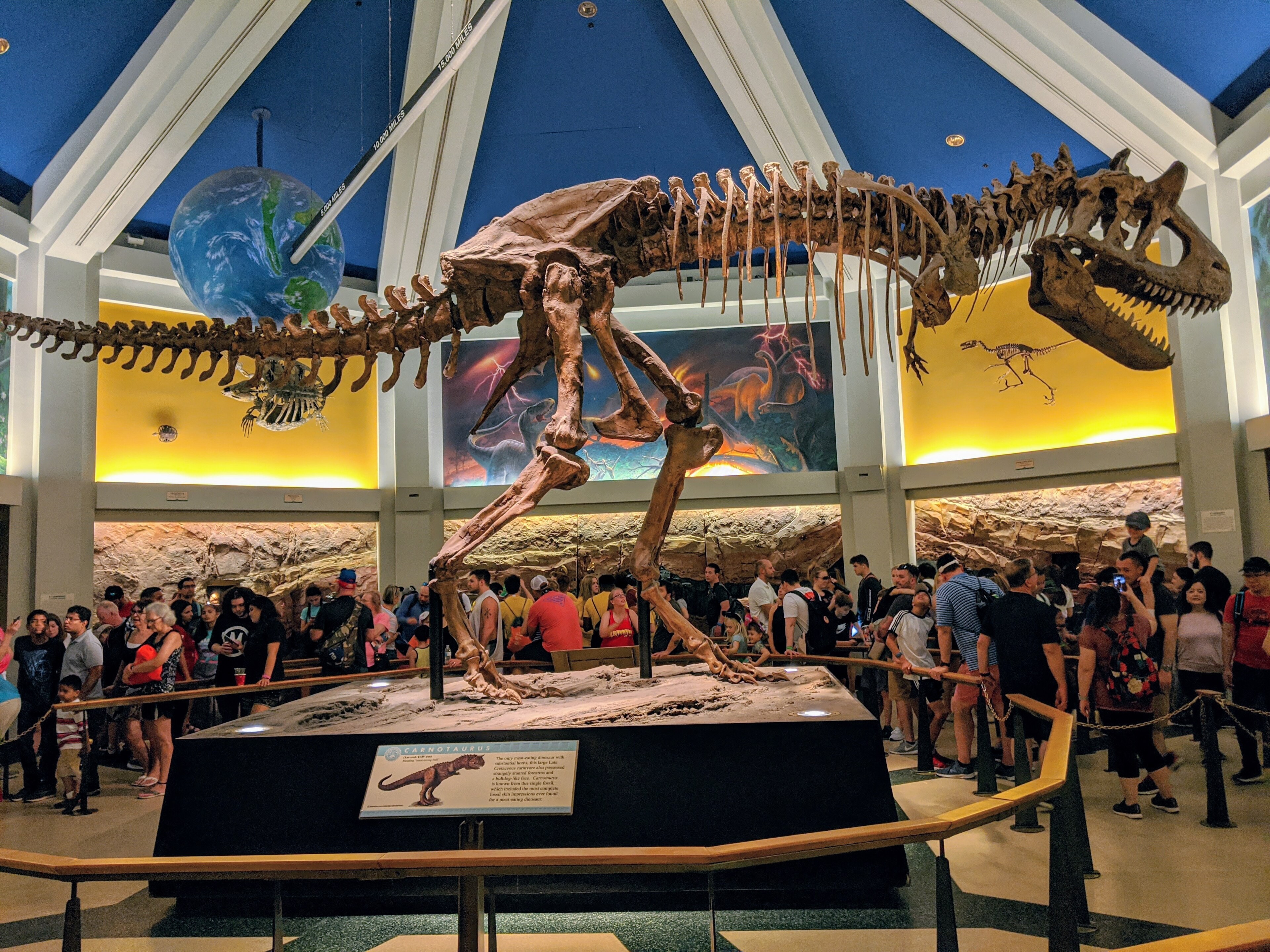
Only one Carnotaurus fossil has ever been found: the holotype, catalog number MACN-CH 894, dug up in 1984 in the La Colonia Formation of Chubut Province, in Argentina's Patagonia region. Paleontologist José Bonaparte described it in 1985. Because there is exactly one specimen, there is no basis for any claim about how Carnotaurus individuals varied, by sex or otherwise. That's a limit worth keeping in mind for everything that follows.
That single skeleton preserved something rare: extensive skin impressions, a mix of small ~5mm scales and larger cone-shaped "feature" scales, with no trace of feathers. And its shoulder is genuinely strange: the head of the humerus is bulbous, almost ball-and-socket-like, implying a far wider range of motion at the shoulder than any other known theropod arm. That's not an inference from behavior. That's what's sitting in the rock.
Tier 2: a real, unsettled debate
Here's the actual scientific argument, and the show doesn't invent it. It's already live in the literature. Could those famously tiny arms have done anything at all?
For some function: a 2017 study in the Journal of Anatomy by Sara Burch, working on the closely related abelisaurid Majungasaurus crenatissimus, found that its shoulder musculature had traded raw force for range of motion, evidence the forelimb wasn't simply dead weight. A 2018 Scientific Reports review by Rafael Delcourt went further, suggesting the reduced forelimb "might have had some display function."
Against significant function: a 2006 study by Phil Senter and Michael Parrish, working directly on Carnotaurus, found a functionally near-immobile elbow joint. A 2010 study by Senter classed abelisaurid forelimbs as vestigial outright, pointing to a reduced nerve supply comparable to flightless birds like emus and kiwis.
Tier 3: what the show invented
None of the choreography itself is preserved in any fossil: not the specific bowing-and-rearing sequence, the blue coloration, the calls, or the cleared display arena. There's no trace evidence tying a display behavior specifically to Carnotaurus. It's built from phylogenetic bracketing (inferring traits by looking at birds and crocodilians, the two living lineages that "bracket" dinosaurs on the family tree) plus deliberate artistic license.
The scene directly adapts an idea from the 2012 book All Yesterdays by John Conway, C.M. Kosemen, and Darren Naish, which challenged paleoartists to imagine extinct animals doing weirder, more animal-like things than the default "generic monster" pose. Reported production color adds the rest: the arm-twirl was partly inspired by consultant Mark Witton's own pet rooster; the dance steps borrow from the real courtship display of a grouse; the vocalizations draw on a cassowary's call.
Even the show wasn't fully right
One more twist: the CGI model shows Carnotaurus's larger feature scales lined up in neat parallel rows. A 2021 study by Christophe Hendrickx and Phil Bell, examining the actual fossil's integument, found those feature scales are randomly distributed across the skin, not arranged in rows at all. The show's model had already been finished before that paper published.
So, Was It Real?
Not a yes, and not a no. The anatomy is real, and genuinely bizarre: a shoulder built for motion nobody expected in a theropod arm. The idea that the arms did something is reasonably, if contestedly, supported in the peer-reviewed literature. But the specific dance (the steps, the color, the sound) is an educated guess dressed in extremely convincing CGI, not an observed behavior. That nuance is the actual story, and it's more interesting than either a flat "fake" or an unqualified "yes."
Why this belongs in PaleoDex
This is exactly the kind of claim PaleoDex exists to sort out: a viral scene, a real fossil underneath it, a live scientific fight most viewers never hear about, and a clearly-marked layer of artistic invention on top. Knowing which tier a claim sits in (fossil, inference, or guesswork) is the whole skill. Read more myth-vs-record deep dives from the record.
Sources
Every fact above is drawn from the primary literature:
- Bonaparte, J.F. (1985). "A horned Cretaceous carnosaur from Patagonia." National Geographic Research 1(1):149–151. (original description of Carnotaurus sastrei, holotype MACN-CH 894)
- Burch, S.H. (2017). "Complexities of forelimb evolution in theropod dinosaurs: shoulder girdle myology of Majungasaurus crenatissimus." Journal of Anatomy 231(4):515–531. (Wiley Online Library)
- Senter, P. & Parrish, J.M. (2006). "Forelimb function in the theropod dinosaur Carnotaurus sastrei, and its behavioral implications." PaleoBios 26(3):7–17.
- Senter, P. (2010). "Vestigial skeletal structures in dinosaurs." Journal of Zoology 280(1):60–71.
- Delcourt, R. (2018). Ceratosaur review. Scientific Reports 8:9730.
- Hendrickx, C. & Bell, P.R. (2021). Study on Carnotaurus sastrei skin-scale distribution.
- Conway, J., Kosemen, C.M., & Naish, D. (2012). All Yesterdays: Unique and Speculative Views of Dinosaurs and Other Prehistoric Animals. Irregular Books.
- Prehistoric Planet (2022), Apple TV+ / BBC Studios Natural History Unit, Episode 5 "Forests," the scene discussed throughout, referenced for commentary and analysis.
The real record, in your pocket.
PaleoDex catalogues the real fossil record, and every fact in it is sourced. Get the app.
GET IT ON GOOGLE PLAY →