Archaeopteryx: The Fossil That Arrived Right on Cue for Darwin
PALEODEX · 21 July 2026 · 8 min read
In 1859 Darwin's critics had one demand: show us the in-between. Show us an animal caught halfway between two kinds of creature. Two years later, a German limestone quarry handed them exactly that, and then the story got strange.
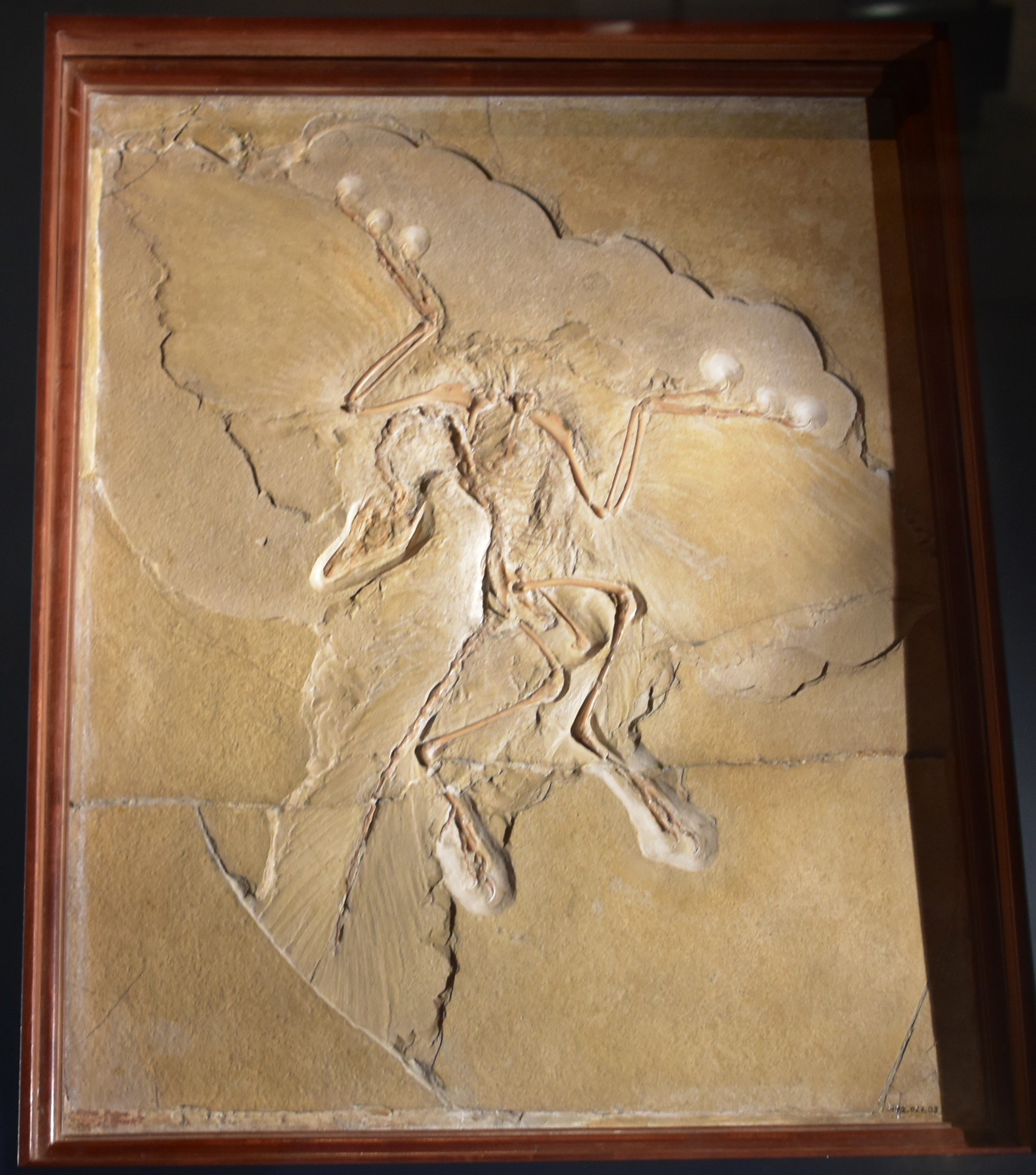
On the Origin of Species was published on 24 November 1859. The objection that followed was not really about mechanism, it was about evidence: if one kind of animal genuinely grades into another over time, where are the fossils caught in the middle? In 1861, a quarry in Bavaria answered.
It started with a single feather
Workers splitting the fine-grained Solnhofen Limestone uncovered the print of one fossil feather, roughly 150 million years old (the Solnhofen beds date to about 150.8–148.5 million years ago, in the early Tithonian). The German paleontologist Hermann von Meyer described it and gave it a name: Archaeopteryx lithographica. Ancient wing.
A feather on its own is already remarkable, because feathers almost never fossilise. But a feather implies an animal, and the same rock was about to produce one.
Then the whole animal, for £700
That same year, near the village of Langenaltheim, the limestone gave up an almost complete skeleton with feather impressions preserved in the stone around it: the specimen now known as the London specimen, catalogued as BMNH 37001. It passed to a local doctor, Karl Häberlein, reportedly in return for medical services, and the British Museum bought it for £700. That was a small fortune in 1861.
Darwin's fiercest critic wrote it up
Here is where the story turns strange. The fossil was described in 1863 by Richard Owen, and Owen was one of Darwin's most prominent critics, openly hostile to natural selection in print from 1860 onward. The specimen that looked like the strongest possible evidence for Darwin's in-between animal was acquired and formally published by the man arguing against him.
And Owen's verdict? He looked at the feathers, the wings and the skeleton, and classified the animal, unequivocally, as a bird.
Two names, one animal, and 150 years to sort it out
Owen did not use von Meyer's name for the skeleton. He gave it a separate species name of its own, leaving the feather and the skeleton formally attached to different names, a real taxonomic tangle rather than a tidy sequence of discovery.
Untangling it took a century and a half. Not until 2011 did the International Commission on Zoological Nomenclature settle the matter, with Opinion 2283 setting aside the earlier type fixations and designating the London skeleton (BMNH 37001) as the neotype of Archaeopteryx lithographica. The reason given is instructive: the original holotype, the isolated feather, simply is not identifiable to species, and could belong to any of several Solnhofen birds.
Reptile and bird, in one piece of stone
Strip away the history and look at what is actually in the slab. It had feathers. It had wings. It also had teeth set in its jaws, claws on its fingers, and a long, bony tail. Three things no living bird has. That combination is the whole point: not a bird, not a reptile, but a mosaic of both preserved in a single animal.
Darwin himself added it to the fourth edition of On the Origin of Species in 1866, describing "that strange bird, Archaeopteryx, with a long lizardlike tail... and with its wings furnished with two free claws."
We still don't agree what colour it was
A hundred and sixty years on, that first isolated feather is still an argument.
In 2012, a team led by Ryan Carney analysed the feather's fossilised melanosomes (the microscopic structures that carry pigment) and concluded it was black. A follow-up in 2020 refined that to matte black with about 90% probability. But in 2013, a team led by Phillip Manning mapped the feather's chemistry using synchrotron X-ray imaging and reached a different conclusion: not solid black but patterned, pale at the base with a dark edge and tip.
There is a third open thread. In 2019, Thomas Kaye and colleagues used laser-stimulated fluorescence to reveal the feather's previously invisible quill, and argued it may not belong to Archaeopteryx at all. Carney's team pushed back in 2020, arguing from nine anatomical attributes that it is an upper major primary covert from an Archaeopteryx wing.
And in 2025, it still wasn't finished
In May 2025, researchers described the fourteenth known specimen: the Chicago Archaeopteryx. Found near Solnhofen by a private collector before 1990 and held privately for decades, it was acquired by Chicago's Field Museum in August 2022. It is the smallest Archaeopteryx ever found, roughly the size of a pigeon.
High-resolution CT scanning revealed something no previous specimen had preserved: tertials, the long feathers on the upper arm that fill the space between the wing and the body. Their absence would leave a gap, and as co-author Jingmai O'Connor put it, "if air passes through that gap, that disrupts the lift you're generating, and you can't fly." Tertials have never been observed in any non-avian feathered dinosaur, which makes them a flight-related innovation, and led the team to identify Archaeopteryx as the earliest known dinosaur able to use its feathers to fly.
A fossil that turned up two years after Darwin's critics asked for one, and 165 years later we are still arguing about its colour and still finding new anatomy in its bones.
Sources
Every fact above is drawn from primary and institutional sources:
- O'Connor, J. et al. (2025). "Chicago Archaeopteryx informs on the early evolution of the avian bauplan." Nature. doi:10.1038/s41586-025-08912-4 (nature.com)
- International Commission on Zoological Nomenclature (2011). Opinion 2283 (Case 3390): Archaeopteryx lithographica von Meyer, 1861 (Aves): conservation of usage by designation of a neotype. Bulletin of Zoological Nomenclature 68(3). (bioone.org)
- Carney, R. M., Vinther, J., Shawkey, M. D. et al. (2012). "New evidence on the colour and nature of the isolated Archaeopteryx feather." Nature Communications. (nature.com)
- Carney, R. M., Tischlinger, H. & Shawkey, M. D. (2020). "Evidence corroborates identity of isolated fossil feather as a wing covert of Archaeopteryx." Scientific Reports 10:15593. doi:10.1038/s41598-020-65336-y (ncbi.nlm.nih.gov)
- Manning, P. L. et al. (2013). Synchrotron chemical imaging of the isolated Archaeopteryx feather. Journal of Analytical Atomic Spectrometry. (chemistryworld.com)
- Darwin, C. (1866). On the Origin of Species, 4th edition — "that strange bird, Archaeopteryx." (darwin-online.org.uk)
- Wikipedia, "Archaeopteryx" and "Specimens of Archaeopteryx" (London specimen, Häberlein, £700, von Meyer's 1861 letters). (en.wikipedia.org)
- Britannica, "Richard Owen" — Owen's public opposition to natural selection. (britannica.com)
The real record, in your pocket.
PaleoDex catalogues the real fossil record: sourced, and honest about what is still disputed. Get the app.
GET IT ON GOOGLE PLAY →